
|
10 lei silver 2026 - National Red Cross Society of Romania - 150 Years since Establishment |
|
| 
|
|
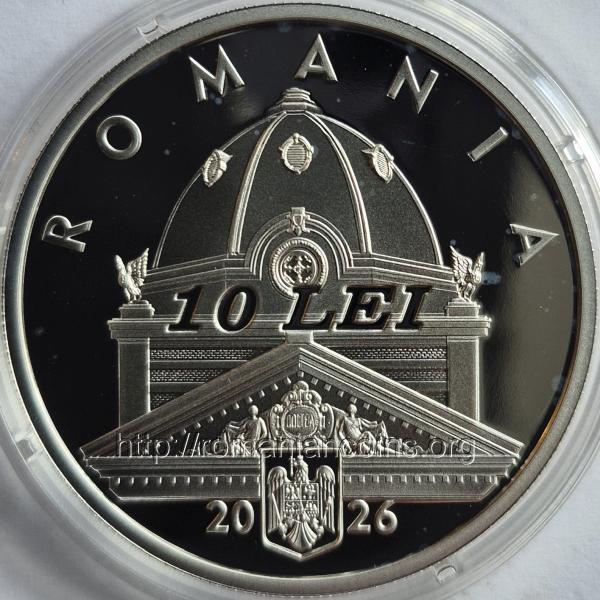
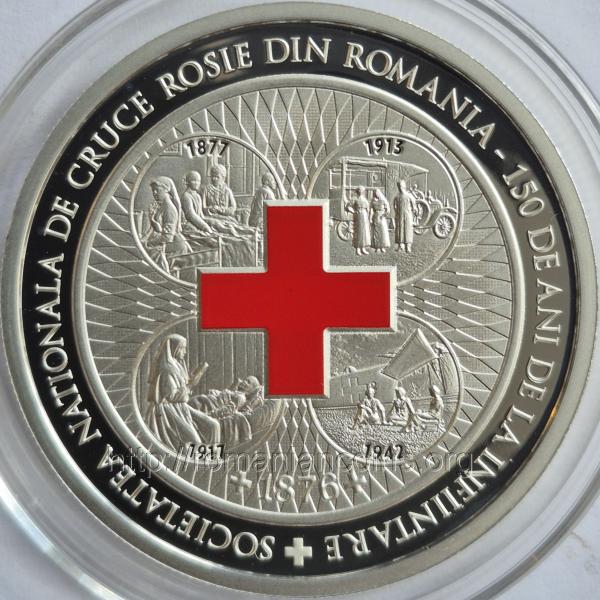
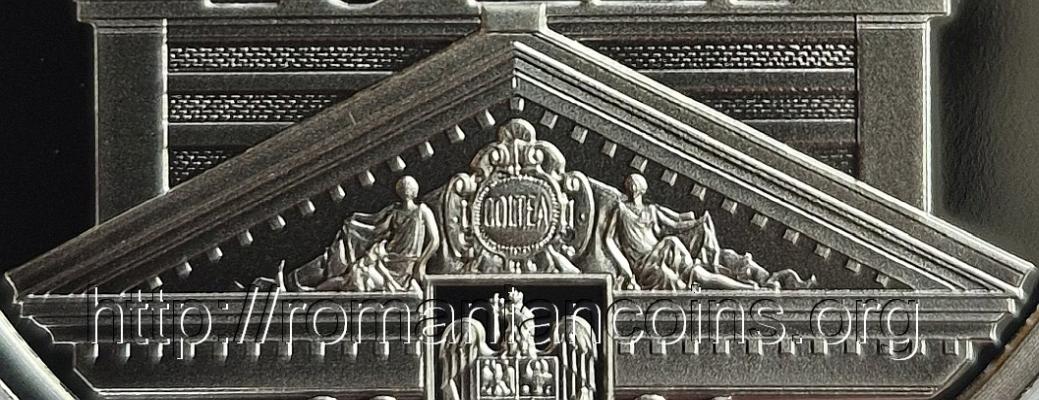
37 mm diameter, 31.103 g, 99.9% silver, reeded edge Obverse: ROMANIA, face value 10 LEI, year 2026, coat of arms of Romania, the pediment and the dome of Colțea Hospital (the first headquarters of the Romanian Red Cross were established was at Colțea Hospital) | Reverse: a red cross in the foreground (painted in color); in the field, four scenes from the years 1877, 1913, 1917, and 1942, depicting activities carried out by representatives of the Romanian Red Cross during the wars in which Romania was involved; circular inscription "SOCIETATEA NATIONALA DE CRUCE ROSIE DIN ROMANIA – 150 DE ANI DE LA INFIINTARE" meaning "NATIONAL RED CROSS SOCIETY OF ROMANIA - 150 YEARS SINCE ESTABLISHMENT" and the founding year, 1876
Issuing date: 2nd of July 2026 Maximum mintage: 500 coins |
About the National Red Cross Society of Romania
The Red Cross Society of Romania was established on July 4, 1876, in Bucharest. In 1906, the Red Cross Society of Ladies of Romania was founded.
In the image from the War of Independence of Romania (1877-1878), several ladies appear wearing armbands with a red cross. One of them is Elisabeta (1843–1916), the wife of Carol I (who, in 1877, was only "Domn" of Romania, proclamation as King occurring only in 1881).
The image marked with the year 1913 depicts an ambulance vehicle that likely operated south of the Danube, in Bulgaria, during the Second Balkan War.
The image with year 1917 depicts Queen Marie reading to a wounded soldier in a field hospital. The hospital is the one at Coțofenești [1]. This probably refers to the village of Coțofănești in Bacău County, village situated between Onești and Adjud. In 1917, the village was close enough to the front line for a military hospital to be established there. A file (reel) shared on Facebook by the Cotroceni National Museum also reveals the exact date when the photograph was taken: October 22 / November 4, 1917 [2].
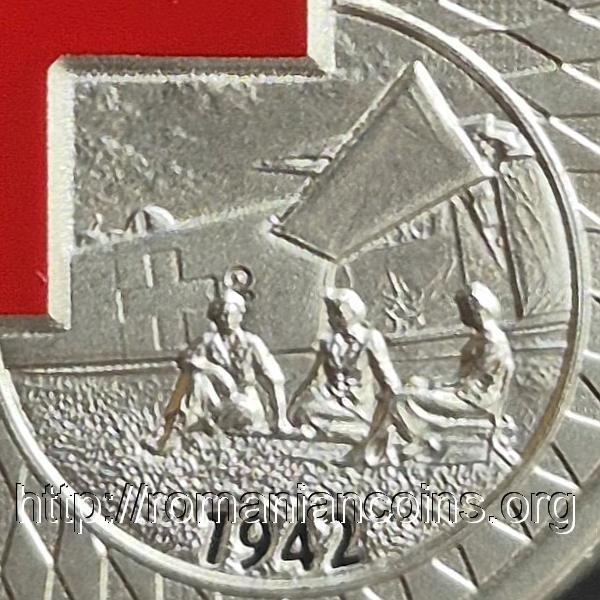
The image from 1942 features "Escadrila Albă" (White Squadron). This was a military medical aviation unit, established in 1940 under the name "Escadrila Sanitară" (Medical Squadron). The squadron's aircraft were painted white and marked with the Red Cross emblem. Several female pilots were also accepted into the squadron, however they were not the only members, as claimed by the legend created around the squadron.
About "Escadrila Albă" (White Squadron)
This squadron included Nadia Russo (Nadejda Evgenievna Brjozovskaya, 1901–1988), Mariana Drăgescu (1912–2013), Virginia Thomas (1910–1996), and Virginia Duțescu (1908–1970), as well as other women [3]. In 1942, the Medical Squadron was renamed Escadrila 108 Transport Ușor (the 108th Light Transport Squadron) [3].
The squadron was equipped with Polish RWD 13S three-seater air ambulance planes. The aircraft bore identification numbers: the one numbered 1 was piloted by Nadia Russo, the one numbered 2 by Mariana Drăgescu and the third was assigned to Virginia Thomas [3]. In the image on the coin, the aircraft bears the number 2, meaning it was piloted by Mariana Drăgescu. The RWD 13S aircraft had enough space to carry a stretcher with one person on it.
In spite of exaggerated claims on the Internet that this squadron was composed "exclusively" out of women, the truth is that a significant number of men were part of the unit as well. The booklet of the Romanian mint medal (see below) boasts that "Era singura unitate de aviație militară din lume formată exclusiv din femei". [It was the only military aviation unit made exclusively out of women.] All of the unit's commanders were men. For instance, at the beginning of the war, the Medical Squadron was commanded by lieutenant aviator Traian Demetrescu [3]. The Medical Squadron’s inventory also included a French-made Potez 65 aircraft, which was piloted by "adj. șef" aviator Nicolae Popescu [3] (it was the highest of the enlisted ranks, just below officers, quite equivalent with master sergeant). "Adj. șef" aviator Aurel Călinescu and 2nd lieutenant medic Mihai Georgescu died in August 1941 in an aviation accident that also cost the squadron one lost aircraft. Additionally, a medical orderly named Gheorghe Ernest is also mentioned as a member of the squadron [3].
About the book "Escadrila Albă" (White Squadron) and about the movie with the same name
The writer George Acsinteanu (1905–1987) published the book Escadrila albă (Biruitorii, oameni cu suflete de zei, cartea a II-a, 1942) (White Squadron, The Victors: People with Souls of Gods, 2nd book, 1942), in which he presented — in an artistic (and propagandistic) manner — the activities of the female aviators of this squadron.
From the newspaper Timpul (Time) dated December 23, 1944 [4] we learn that Acsinteanu’s volume was "withdrawn from circulation" in December 1944. "Comisiunea Română pentru Aplicarea Armistițiului" (Romanian Commission for the Implementation of the Armistice), invoking Article 16 of the Armistice Convention — which also concerned "the dissemination of periodical and non-periodical publications in Romania" — placed the book on "list No. 2" of withdrawn works. The official announcement later appeared in the Monitorul Oficial (Official Gazette) [5], from which we learn that the measure targeted various "periodical or non-periodical publications deemed capable of damaging, through their content, the good relations with the United Nations". All such materials were required to be handed over to the county prefectures within 15 days. In Bucharest, they had to be delivered directly to "Oficiul de hârtie" (Paper Office) depot located at 63–67 Tudor Vladimirescu Boulevard.
In 1942, a collaboration between Romania and Italy began in the field of cinema [6]. The first film was to be "Escadrila Albă" (or "Squadriglia bianca" in the Italian version), inspired by the actions of "Romanian female pilots who ventured to the first front lines to transport the wounded to hospitals behind the front" [6].
The film "The White Squadron" was shot — king Mihai even attended some of the filming sessions — but it appears that the Romanian language version was never completed. Nowadays, the film is considered lost. Another Italian-Romanian co-production was filmed and released in 1942 under the title "Odessa în flăcări" ("Odessa in Flames", or "Odessa in fiamme" in the Italian version). The Romanian singer Maria Cebotari starred in the film. This movie, which was thought to have been lost after the war, was discovered by chance in 2004 and has been reconditioned.
Who is the author of the syntagm "White Squadron"?
Currently (2026), an opinion widely spread on the Internet is that the name "Escadrila Albă" (White Squadron) was coined by the Italian journalist Curzio Malaparte (the pseudonym of Kurt Erich Sucker, 1898–1957). He served as a correspondent for the prominent Italian newspaper "Corriere della Sera" starting in 1941. The Romanian version of Wikipedia entry dedicated to him [7] claims that Malaparte never even reached the front; it asserts that he obtained his information regarding Romania from Romanian diplomats at the Romanian embassy in Finland and that he actually wrote his war correspondences from the front while in Italy. It should be noted, however, that the Italian version of Wikipedia page for Malaparte [8] completely contradicts the claims made in the Romanian version, stating that during the war Curzio Malaparte was present in Greece, Yugoslavia, Romania, Ukraine, Poland, and Finland. Nevertheless, there is a consensus that his reports lean much closer to literature than they ought to and that at least some of the details are fabricated.
The earliest reference we have found appears in the newspaper Universul (Universe) on August 12, 1941 [9], which published a war correspondence named "Escadrila Albă" ("The White Squadron"), signed by "George Acsinteanu, war correspondent (P.P.)". We learn the meaning of "P.P." from Acsinteanu’s own book, in which he explains that he spent three months on the front as a "volunteer with the Propaganda Platoons of the General Staff". The author notes that the medical squadron was deployed to the front following the fights at Basarabeasca and Țiganca in Southern Basarabia. The small aircrafts flown by "our female fliers" arrived at Basarabeasca to collect the wounded, who were then transported to Hîncești, a location accessible to the squadron’s 12-seater plane, "the large aircraft that gives the impression of a hospital room" [10].
Another mention is from Universul (Universe) of September 14, 1941 [11], which announces that Raffaello Guzman (1905-1984 Italian journalist and aviator) published in the newspaper Il Messaggero a correspondence from the front, namely from Odesa, with the title... "Escadrila Albă". Unfortunately, the date on which the article appeared in Italy is not mentioned.
In June 1942, Acsinteanu sent to the editorial secretary of the Viața (Life) newspaper of Bucharest (director, Romanian writer Liviu Rebreanu) a letter of protest [12] in which he pointed out that in the article "Romanian women in the holy war: talking to aviator Mariana Drăgescu from the Escadrila Albă" signed by Doina Peteanu, the author repeatedly uses the phrase Escadrila Albă (White Squadron) without mentioning that this syntagm was created by Acsinteanu, who also wrote a book with this title. Acsinteanu shows that he accepted that the film director Ion Sava would use the name for a film he was working on. As it can be seen, in 1942 Acsinteanu quite vehemently claimed the literary ownership of the term "Escadrila Albă".
In 1943, the Romanian press reported the publishing in the Italian magazine "Tempo" of the illustrated article "Escadrila albă", an article signed by Bruno Siliani [13]. There is also a mention that the name of the squadron was given by Curzio Malaparte.
We were not been able to find any direct evidence that the Italian journalist Curzio Malaparte used the expression "Squadriglia bianca" (Italian translation of "Escadrila albă"), or that he wrote anything about the women aviators of Romania - not even after August 12, 1941. In the volume "The Volga Rises in Europe" (original title: Il Volga nasce in Europa, 1943, text available in a post-war English translation on the Internet Archive), volume containing at least some of the war correspondences from the Eastern front, we have not found even a single mention of the "White Squadron". Until the appearance of such historical evidence, the authorship of the expression should again be attributed to the Romanian writer George Acsinteanu and the Curzio Malaparte version should be put under the sign of doubt, as a wartime myth.
"The White Squadron – Romania’s Heroic Aviatrices" – medal struck by the State Mint of Romania
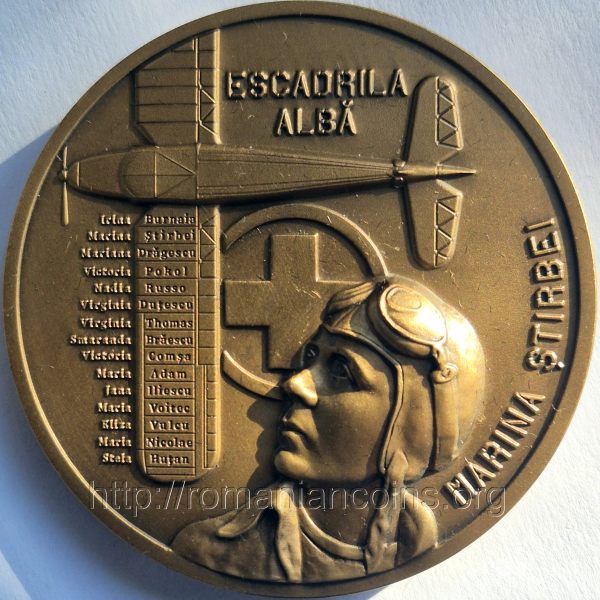
The obverse of the medal pays tribute to the aviatrix Marina Știrbei (1912–2001). A member of the Red Cross Society, she initiated the organization of an aerial medical service in which aircraft could also be piloted by women. In 1939 she submitted a petition to "Ministerul Aerului și Marinei" (Minister of Air and Navy) [3]; the proposal was approved, leading to the establishment of the Medical Squadron. Consequently, even though she did not fly medical aircraft during the war, Marina Știrbei’s name remains linked to the founding of the "White Squadron".
The aviatrices whose names are inscribed on the airplane's wing are: Irina Burnaia, Mariana Știrbei, Mariana Drăgescu, Victoria Pokol, Nadia Russo, Virginia Duțescu, Virginia Thomas, Smaranda Brăescu, Victoria Comșa, Maria Adam, Jana Iliescu, Maria Voitec, Eliza Vulcu, Maria Nicolae and Stela Huțan.
Irina "Burnaia" (Irina Cioc, 1909–1997) served during the war as pilot for Squadron 117, a postal squadron belonging to the Transnistria Governorate. Victoria Pokol (1903?–1950) participated in the war (during the Stalingrad campaign) as a liaison pilot, flying her own personal aircraft, a two-seater Bücker Bü 131 "Jungmann" [3]. Smaranda Brăescu (1897–1948) began the war as an instructor at a paratrooper school. In 1942 she served as a liaison pilot at 108th Light Transport Squadron and in 1943 she transferred to the 105th Heavy Transport Squadron [3].
The Medical Squadron was officially established on June 25, 1940 [3]. Initially, it was equipped with two Monospar ST-25 Universal aircraft. Less than a month after its formation, on July 21, the squadron lost its first aircraft during a training flight that departed from the Băneasa airfield (where the Medical Squadron was based). The aviatrices Victoria Comșa (1910–1940), Maria Adam (1919–1940), Jana Iliescu (1912–1940) and Maria Voitec (~1915–1940) were on board that aircraft and died in the accident [3].
During the war Eliza Vulcu (1922–1998) served as a liaison pilot for "Grupul Aerotransport Militar" (Military Air Transport Group) [3]. From 1942 to 1943 Maria Nicolae (1916–?) served as a liaison pilot at the 108th Light Transport Squadron. Stela Huțan (1921–2010) flew for the 108th Light Transport Squadron in 1943.
It should be noted that female aviators were not unknown to the Romanian public during the interwar period. In 1937, there were already 13 women in the country who held pilot’s licenses obtained in Romania [14]: Ioana Cantacuzino, Irina Burnaia, Florica Delescu, Victoria Pokol, Felicia Bădiliță, Valeria Ionescu, Marina Știrbey, Mariana Drăgescu, Virginia Thomas, Nadejda Russu, Mihaela Frim and Virginia Duțescu. The latter four are described by the cited newspaper as "distinguished sportswoman" [sic]. Smaranda Brăescu was also a pilot, though she had obtained her license in the United States of America. It is also mentioned that Irina Burnaia had attempted, in vain, to join the ranks of the military air force.
It should also be noted that the female aviators of the interwar period and the Second World War were not forgotten during the communist era. For instance, in an article from the newspaper Sportul (Sport) from 1968 [15], the female author mentions several dozen "sisters" who etched their names into the history of aviation sports. It was also mentioned << ... that "white squadron" for transporting the wounded >> as well as the aviatrices who perished in an accident in 1940. Furthermore, it is noted that Maria Voitec was the sister of Ștefan Voitec (1900–1984), a politician who was President of the Grand National Assembly of Romania between 1961 and 1974.
| 
|
|
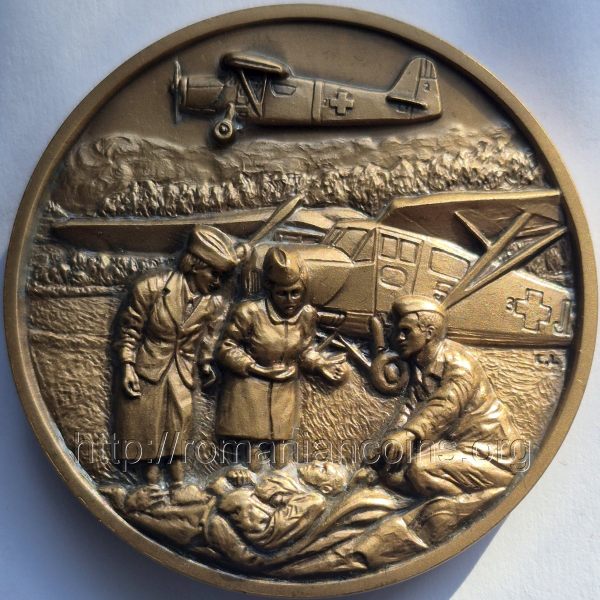
60 mm diameter, 167 g, patinated copper alloy, flat edge Obverse: a circle with a cross (symbol of the Red Cross), an airplane (which must be a Polish RWD 13S ambulance plane), an image of the aviatrix Marina Știrbei, inscriptions "ESCADRILA ALBĂ" meaning "WHITE SQUADRON" and MARINA ȘTIRBEI; on the airplane's wing are the names of 15 aviatrices | Revers: a scene depicting the evacuation of a wounded man from the front: a soldier brings in a wounded on a stretcher, while two women (the air ambulance crew) prepare the boarding; in the background stands the aircraft with number 3; on the background flies the plane no. 2 of the squadron (the one piloted by Mariana Drăgescu)
Fixed mintage: 40 medals |
Even though no names appear on the reverse of the medal, two individuals can be identified. The RWD 13S aircraft no. 3 of the Medical Squadron was piloted by Virginia Thomas [3], so she must be one of the two women. But which one? The answer is relatively simple. Virginia Thomas is on the left, wearing a military tunic with a distinctive collar and lapel. The second woman must be the volunteer nurse Ioana Grădinescu, who is wearing a nurse uniform with a rounded collar.
About the Aviatrix Virginia Thomas, Featured on the State Mint Medal
Virginia Thomas was born in Brașov [3], which at the time — 1910 — was part of Austria-Hungary.
Some information about Virginia Thomas can be found in the press of the era. For instance, on September 28, 1936 [16], she piloted a Messerschmitt light aircraft on a flight from Cluj to Bucharest. Two and a half hours after departure, she reached Roșiori, where she attempted to land the plane on a stubble field. As darkness was already falling, the aircraft’s wing struck a telegraph pole during the landing. The plane was completely destroyed, but Virginia and her passengers escaped unharmed.
In 1938 the Royal Aeronautical Federation of Romania and the Civil Aviation Directorate within the Ministry of Air and Navy granted Virginia Thomas the necessary authorization to purchase a touring aircraft [17]. (It appears that, at the time, the state provided financial support for the purchase of aircraft by covering a portion of the costs.)
In 1939 Virginia Thomas worked as a stewardess. The newspaper Seara (Evening), in its June 6 issue [18], reports the following: <<...in one corner [of the Băneasa Airport], preparations were underway for the departure of the plane bound for Berlin. The first Romanian "stewardess", miss Virginia Thomas — wearing the traditional uniform of these "guardian angels" of the passengers, with the blue cap perched over one ear — also waits nearby, alongside our number one airline pilot.
In 1942, during a formal ceremony held at the Royal Palace in Bucharest, Queen Mother Elena of Romania presented to the members of the Red Cross who had distinguished themselves in their service a "Red Cross badge, engraved with the Crown and the initials of Her Majesty Queen Mother Elena" [19]. The first woman to be decorated was — quite predictably — Maria Antonescu (1892-1964), the wife of Marshal Antonescu (1882-1946), Conducătorul Statului (Leader of the State of Romania at that time)... The four female pilots from the medical aviation unit — Maria Drăgescu, Virginia Duțescu, Nadia Russo and Virginia Thomas — were honored with this Red Cross badge, as was the nurse Ioana Grădinescu. A large number of other women — ladies and young ladies alike — who served on Red Cross vehicles were also decorated.
In 1943, following the dissolution of the squadron (the aircraft were heavily worn and no longer safe for flight), Virginia Thomas moved to Red Cross Hospital No. 3, where she drove a vehicle used for transporting the wounded [3].
In 1946, Virginia Thomas married an English officer [20] and, some time later, left Romania: "At the civil registry office of the Roșu district [Red, a district in Bucharest, which at the time was divided in "colours"], the marriage of Miss Virginia Thomas, the pilot aviatrix, with Mr. Andrew Klinghardt, an English captain, was celebrated". Andrew Klinghardt (1916–1967) was a British intelligence officer. He served during the war and remained in the military until his retirement in 1963. In 1946, he was posted to Bucharest, where he served as a security officer and Russian-language interpreter for the British Military Mission in Romania. He died suddenly while on vacation with his wife [21].
References
1. Ion N.D. (coordonator), Maria a României. Portretul unei mari regine. volumul II, Muzeul Național Peleș, Sinaia, 2018.
2. * * *, O lume la răscruce sau libertatea ca reponsabilitate. Regina Maria a României pe frontul Marelui Război, Muzeul Național Cotroceni, Facebook.
3. * * *, Escadrila Albă - pagina în română, Wikipedia, accesată noiembrie 2026.
4. * * *, Alte cărți retrase din circulație. Timpul, anul VIII, Nr. 2730, 23 decembrie 1944, București.
5. Monitorul Oficial (Partea I), nr. 66, 21 martie 1945.
6. -bib.-, S'au pus bazele unei colaborări cinematografice româno-italiene. „Escadrila Albă” și „Odessa” vor fi primele două mai filme ce urmează să fie realizate chiar în vara aceasta. Cine vor fi interpreții și realizatorii acestor două filme. Viața, anul II, Nr. 390, 18 mai 1942, București.
7. * * *, Curzio Malaparte - pagina în română, Wikipedia, accesată noiembrie 2026.
8. * * *, Curzio Malaparte - pagina în italiană, Wikipedia, accesată noiembrie 2026.
9. Acsinteanu G., Escadrila Albă. Universul, anul al 58-lea, Nr. 216, 12 august 1941, București.
10. Acsinteanu G., Escadrila Albă. Biruitorii, oameni cu suflete de zei, cartea a II-a, 1942, Editura Cugetarea, București.
11. * * *, Eroismul aviatoarelor române. Universul, Anul al 58-lea, Nr. 249, 14 septembrie 1941, București.
12. Acsinteanu G., În jurul reportajului „Escadrila Albă”. Viața, anul II, Nr. 414, 13 iunie 1942, București.
13. * * *, Minunatele acțiuni ale aviatoarelor române. Curentul, anul XVI, Nr. 5585, 4 septembrie 1943, București.
|
Back to selection page!
|