
|
J. N. Jonescu restaurant tokens - Bucharest |
|
|
|
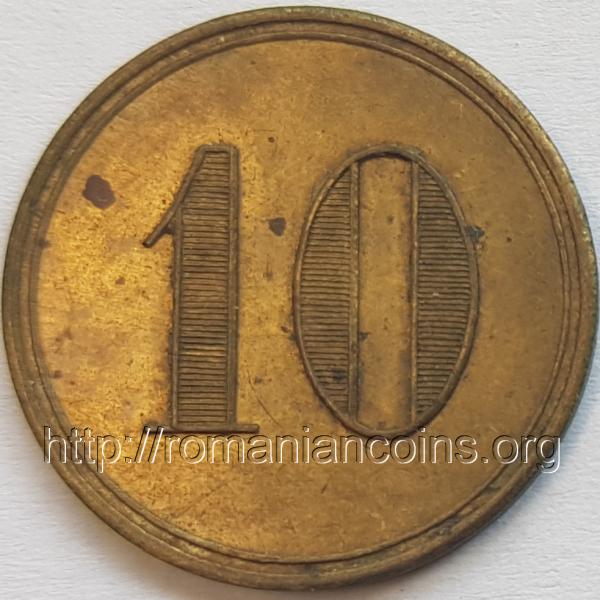
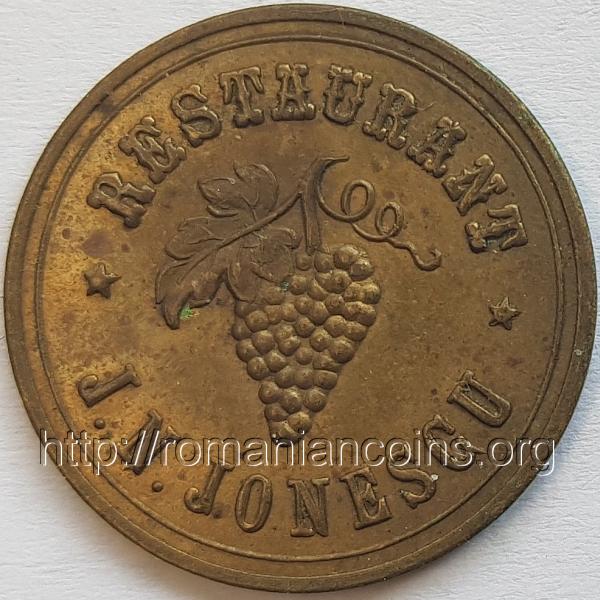
| 20.7 mm, 3.16 g, brass face value 10 inside outer linear circle | outer linear circle, circular inscription ★ RESTAURANT ★ J. N. JONESCU, in center a bunch of grapes, with a leaf and a tendril |
The Jonescu token is present on Romanian tokens through the kind permission of an anonymous donor.
These tokens are listed in [1] and are also presented in an article published in Colecţionarul Român revue [2].
About J. N. Jonescu (Iordache N. Ionescu, 1844-1903) and about His Restaurant
Iordache Ionescu's restaurant was in Bucharest, on 3 Covaci Street. The official name of the restaurant was "La trei frunze de viţă" meaning "At Three Vine Leaves" [3], but it was usually called "La Iordache" (At Iordache). In [3] the restaurant is listed as "birt", a Romanian word describing a rather modest restaurant.
A brief history of the first period of activity of this restaurant is given in a book about the city of Bucharest written by a Frenchman, Frederic Damé [4]. According to this author, the restaurant was founded in 1859 by C. I. Ionescu. In 1875, the first owner retired from business, the restaurant being handed to Iordache N. Ionescu, his nephew. In 1880, the restaurant building (still standing) on Covaci street no. 3 was erected, and in 1890 the firm becomes Iordache N. Ionescu & C-ie, by co-opting Eleuterie Ionescu, a cousin of Iordache. After the death of Iordache N. Ionescu, which occurred in 1903, the company continued to operate under the leadership of Eleuterie [3]. The Iordache Ionescu restaurant operated until after the Second World War. In 1928, it functioned on Oituz street no. 3 [5].
Numerous details from the life of Iordache N. Ionescu are presented in his obituary, published in the newspaper Adevěrul on February 8, 1903 [6]. Iordache was the son of a peasant from Ciochina commune in Ialomiţa county. At first he joined his uncle Constantin, who held the birt called "La rogojină" (meaning "At Reed Mat"). Later he took over the business. He wore an apron and personally served the customers. Iordache and his uncle Constantin are credited with the invention of famous Romanian small sausages named "mititei" (or little ones). Tache Rusescu, Gheorghe Iliescu, Enescu and Ionică Andreescu, Niţă Ionescu and others (who later owned famous restaurants) did their apprenticeship at his restaurant. Tache Rusescu also issued tokens, very similar to those of his former patron. Iordache N. Ionescu was a successful businessman. He also had vineyards in Drăgăşani and produced quality wine. He was one of the 731 Romanian exhibitors who participated in the Universal Exhibition of 1889 in Paris [7]. In 1889 Romania obtained 278 awards, medals of various metals (gold, vermeil = gilt silver, silver, bronze) and mentions - two of which were awarded to Iordache Ionescu: "Ionesco Iordache" from Bucharest received a silver medal for his "vins blancs de Dragasani et de Tamaiosa". His "ţuica" (a strong brandy made of fermented plums) was also awarded a bronze medal [7].
Constantin Bacalbaşa, the author of the wonderful book "Bucureştii de altădată" (Bucharests of Yore) [8], mentions the following about Iordache N. Ionescu's restaurant:
|
"The current building of the Iordache restaurant in Covaci was not there yet. In its place a similar shed. You went in by stooping, but food being good, there were plenty of people. The great buzz of this restaurant which had a genuinely Romanian cuisine, started from the day humorist Nae Orăşeanu composed his risible list of dishes which, in part, lived to our times and will live on. Here comes, as far as I recollect, some of N.T. Orăşeanu's nicknames: Bread was called abundance. Ice: Siberian cream. Toothpick: a bayonet. Tableware: a regulation. Ţuica [plum spirit]: an idea. The bill: the protocol. Small sausages: wee ones [mititei]. Big sausages: patricians. A red pepper: a torpedo. Sauerkraut: Belgrade controlled origin. The tiny wine bottle: a trial [or maybe an argument]. Wine bottle and mineral water in coolers: a battery [like an artillery battery]. Water: a natural one. Wine glasses: semi-platoons. Turkish black coffee: a "taifas" [a chatter], etc. etc. The restaurant had even acquired the nickname La idee [At Idea]. But the word was not kept. Instead: the mititei, the battery and the protocol became regular parlance. The mititei and the battery will live long into the future." |
In the chapter referring to the year 1882, Constantin Bacalbaşa mentions again "At Iordache" among the "Romanian restaurants".
The article from the aforementioned Adevérul newspaper [6] also gives some names from the list of dishes written by Orăşanu for Iordache's restaurant: the small sausages were also called Junimists, as for the members of Junimea literary society, the patrician sausages were also called diplomats, the wooden plate - hypocrite, the "oca" of wine (a capacity measure of about 1.3 liters) - (police) report, a half of oca of wine - a republican, a "litră" of wine (a capacity measure of about 1/3 or 1/4 liters) - a trial [or maybe an argument], and hot pepper was also called a torpedo. Also, the article provides some data about the family of Iordache N. Ionescu. He had a son from his first marriage, who in 1903 was a high school student in Braşov, and two boys and a girl from his second marriage. Iordache's fortune was valued at over 400,000 lei in merchandise and over a million in the building in Covaci street no. 3 and in other properties. Among other things, he also owned a villa in the city of Sinaia.
In the "Anuarul Bucurescilor" (Yearbook of Bucharest) of 1895 [9] Iordache N. Ionescu also appears as a censor of the "Bistriţa" Romanian Stock Company, a company that operated the paper factory in Letea. His name also appears as a tobacconist, respectively as the owner of the first "Spălătoria cu aburi" (Steam Laundry) bussiness, on Isvor street no. 56.
In the "Anuarul Bucurescilor" (Yearbook of Bucharest) from 1906 [10] the restaurant on Covaci Street no. 3 appears as "Ionescu N. Iord. S-sor”, so it had already been taken over by Iordache's successors.
References
1. Schäffer E., România. Jetoane, semne valorice şi mărci. Guttenbrun [vechiul nume german al satului Zăbrani din judeţul Arad], 2012.
2. Ciumara T., Jetoanele restaurantelor J.N. Jonescu şi Tache Rusescu. Colecţionarul Român, nr. 10, 2007.
3. * * * , Carte de adrese a Bucurescilor. A 2-a ediţie, Editura Tip. „Românul”, C. Göbl, Bucureşti, 1883.
4. Damé Frédéric, Bucharest en 1906. Socec & C-IE, 1907.
5. * * * (Oficiul Universitar din Bucureşti), Călăuza studentului. Vademecum academicum 1928-1929, Editura "Cartea Românească" Bucureşti, 1928.
6. Fagure E., Moartea lui Iordache din Covaci. Adevěrul. an XVI, nr. 4859, sîmbătă 8 februarie 1903, ediţia de seară.
7. Bibesco G., Exposition universelle 1889. La Roumanie. Avant - pendant - après. Paris, Imprimerie Typographique J. Kugelmann, 1890.
8. Bacalbaşa C., Bucureştii de altădată. vol. I (1871-1877), 1987, şi vol. II (1878-1884), 1993, Editura Eminescu, Bucureşti.
9. * * * , Anuarul Bucurescilor pe anul 1895. Litho-Tip. Carol Göbl, Bucureşti, 1895.
10. * * * , Anuarul Bucurescilor pe anul 1906. Institutul de Arte Grafice Carol Göbl, Bucureşti, 1906.
|
Back to sitemap page!
|